
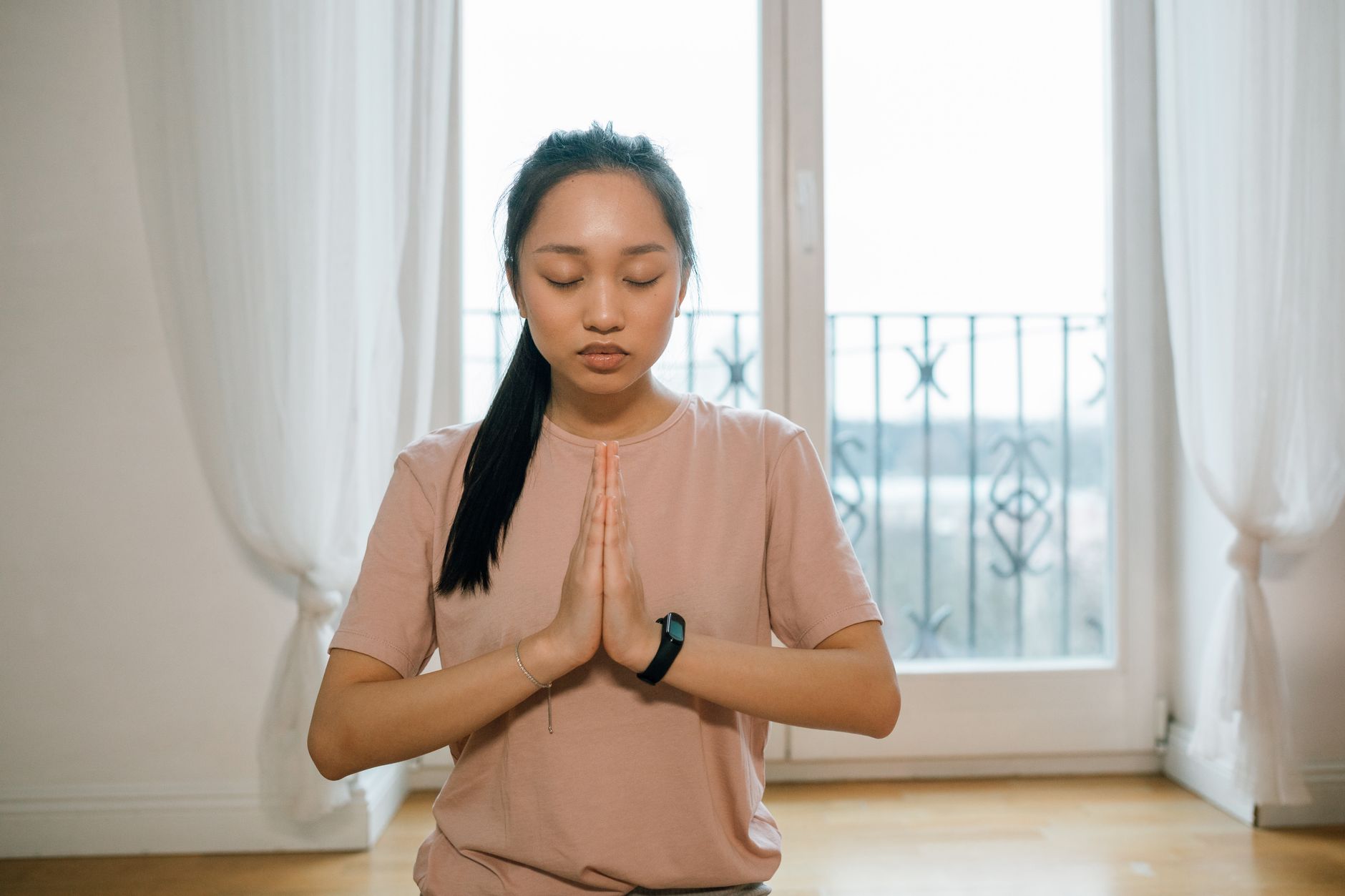
Colour breathing is exactly what it sounds like: you breathe with intention while visualising a specific colour entering or leaving your body with each breath. The practice sits at the intersection of breathwork and imagery therapy, and it's one of the quieter tools in holistic health that tends to surprise people with how quickly it works. You don't need training, equipment or a dedicated space. You need a chair, a minute of privacy, and the willingness to try something that sounds almost too simple.
Why colour, not just breath?
Standard breath awareness works because it anchors attention in the body and activates the parasympathetic nervous system. Colour adds a second layer. When the mind has a visual object to hold, it's less likely to wander back to whatever triggered the stress. Psychologists call this dual-focus attention: you're inside the body feeling the breath, and outside it watching a colour, at the same time. That split keeps the analytical mind occupied while the body does its calming work.
Colour also carries meaning. Research into colour psychology consistently shows that people associate cool colours (blues, greens, soft purples) with calm and warmth, while reds and oranges tend to register as energising or alerting. Colour breathing uses this association deliberately. You're not picking a colour at random. You're asking yourself what your body needs right now, and reaching for the visual equivalent of it.
This is distinct from chromotherapy, which uses external light sources and has its own history and framework. Colour breathing is entirely internal. The colour exists only in your imagination, which means it's available anywhere.
How to do a basic colour breathing session
Start by settling. Sit upright with your feet flat on the floor, or lie down if that's easier. Close your eyes. Take two or three ordinary breaths and let your shoulders drop.
Now choose a colour. If you're anxious or wired, most people reach for a soft blue or a cool green. If you're depleted and flat, a warm gold or gentle amber tends to feel more useful. There's no wrong answer. Trust the first colour that comes.
Breathe in slowly through your nose over a count of four. As you inhale, picture that colour pouring into your body with the breath: filling your lungs, spreading into your chest, travelling down your arms, pooling at your belly. Hold for one or two counts. Then exhale through your mouth over a count of six, and imagine a dull grey or muddy brown leaving your body with that outbreath. That colour represents whatever you're releasing: tension, worry, fatigue.
Repeat this for eight to twelve breaths. Most people notice a shift by the fifth or sixth cycle.
Choosing your colour by what you need
Different states call for different colour choices. The following are starting points, not rules. Let your intuition adjust them.
- Blue or aqua: for anxiety, racing thoughts, or a nervous system stuck in high gear.
- Green: for emotional pain, grief, or when you need to feel held.
- Gold or amber: for exhaustion, low mood, or the flat feeling after a difficult week.
- White or pale violet: for mental clarity, decision fatigue, or when you feel scattered.
- Soft pink: for self-compassion, particularly useful when guilt or self-criticism is running high.
You can also choose two colours: one for the inhale, one for the exhale. Some people find it easier to visualise warmth coming in (gold) and cold leaving (grey). Others prefer a single colour that deepens and brightens as the session continues. Neither approach is superior. The practice is meant to be adapted.
Pairing colour breathing with an existing practice
Colour breathing works well as a standalone two-to-five-minute reset, but it integrates naturally into other practices. If you already have a simple breath awareness practice, colour breathing is a direct extension of it: you're using the same rhythmic foundation and adding a visual layer. Some people use it in the last two minutes of a longer breathwork session, when the nervous system is already settling and the imagery lands more vividly.
It also pairs well with the moments just before sleep. A blue or violet colour breathing sequence in the final minutes before you close your eyes can ease the transition out of an active day. It doesn't require the same kind of focus as journalling or reading, so it doesn't re-engage your analytical mind the way those practices sometimes do.
What to expect when you start
The first session often feels awkward. The colour is abstract, the visualisation is thin, and you might find yourself questioning whether you're doing it right. That's normal. Visualisation is a skill, and colour is slippery to hold compared to, say, a physical sensation.
By the third or fourth session, the colour tends to arrive more readily. Some people report feeling a physical warmth or coolness in the body that corresponds to the colour they're visualising. Others notice the colour intensifying or shifting during the session. Neither response is required. Even a vague, impressionistic sense of colour is enough to anchor the practice.
Children tend to pick this up faster than adults. If you're using it with a child who is anxious or overwhelmed, the simplicity of "breathe in your calm colour, breathe out the yucky feeling" is often enough. The language can be as plain as that.
When to reach for it
Colour breathing is well suited to transitions: the gap between a stressful work call and a family conversation, the ten minutes before a difficult appointment, the moment you arrive somewhere and need to shift gears. It's discreet enough to use in a parked car, a bathroom, or a waiting room.
It's also genuinely useful for carers and anyone managing sustained emotional labour. When stress accumulates across a day without release, the nervous system doesn't just need a breath. It needs a visual and sensory anchor to interrupt the cycle. The colour gives the mind something to do while the breath does the physiological work. Used consistently, even once or twice a day, it builds a small but reliable pathway out of reactivity.
The practice asks very little. That's its real strength.