Jin shin jyutsu is a Japanese healing art that works by placing the hands lightly on 26 specific points on the body, known as Safety Energy Locks. The practice doesn't involve massage, manipulation or needles. The touch is gentle and sustained, often barely perceptible, and yet its effects on tension, fatigue and emotional holding can be quite profound. If you've explored practices like polarity therapy or zero balancing, jin shin jyutsu occupies a similar quiet corner of complementary wellness: subtle, unhurried, and easily underestimated.
Where jin shin jyutsu comes from
The practice was rediscovered and systematised in Japan in the early twentieth century by Jiro Murai, who reportedly used self-healing techniques to recover from a serious illness. Murai spent decades studying ancient texts and refining his understanding of the body's energy pathways before passing the knowledge to Mary Burmeister, an American-Japanese woman who brought it to the United States in the 1950s. Burmeister spent decades teaching and writing about it. Today, jin shin jyutsu is taught through workshops and practitioner training programmes in countries across the world, including Australia.
The name itself translates roughly as "the art of the Creator through knowing and compassionate man." That phrase points to the philosophy at the heart of the practice: that the body already knows how to heal, and that skilled, attentive touch simply clears the path.
The 26 Safety Energy Locks
Jin shin jyutsu maps 26 bilateral points on the body, mirrored on the left and right sides, giving 52 in total. Each point sits on a specific pathway through which life energy, called "qi" in Chinese traditions or "ki" in Japanese ones, is said to flow. When a lock becomes congested or blocked, the theory holds that tension builds in the surrounding area and eventually spreads along the pathway.
The points don't correspond directly to acupuncture points, though there is overlap in the underlying philosophy. A practitioner trained in jin shin jyutsu uses a specific sequence of holds rather than individual point pressure, following a "flow" that addresses a particular complaint or pattern. The same blockage might be approached from several different angles depending on what a person presents with on the day.
What happens in a session
A jin shin jyutsu session typically runs for about an hour. You remain fully clothed and lie on a treatment table. The practitioner begins by listening to the pulses in your wrists, a diagnostic process similar in spirit to what you'd find in traditional Chinese medicine, though the specific reading differs. Those pulses give the practitioner a picture of which pathways are congested and which flows to work with.
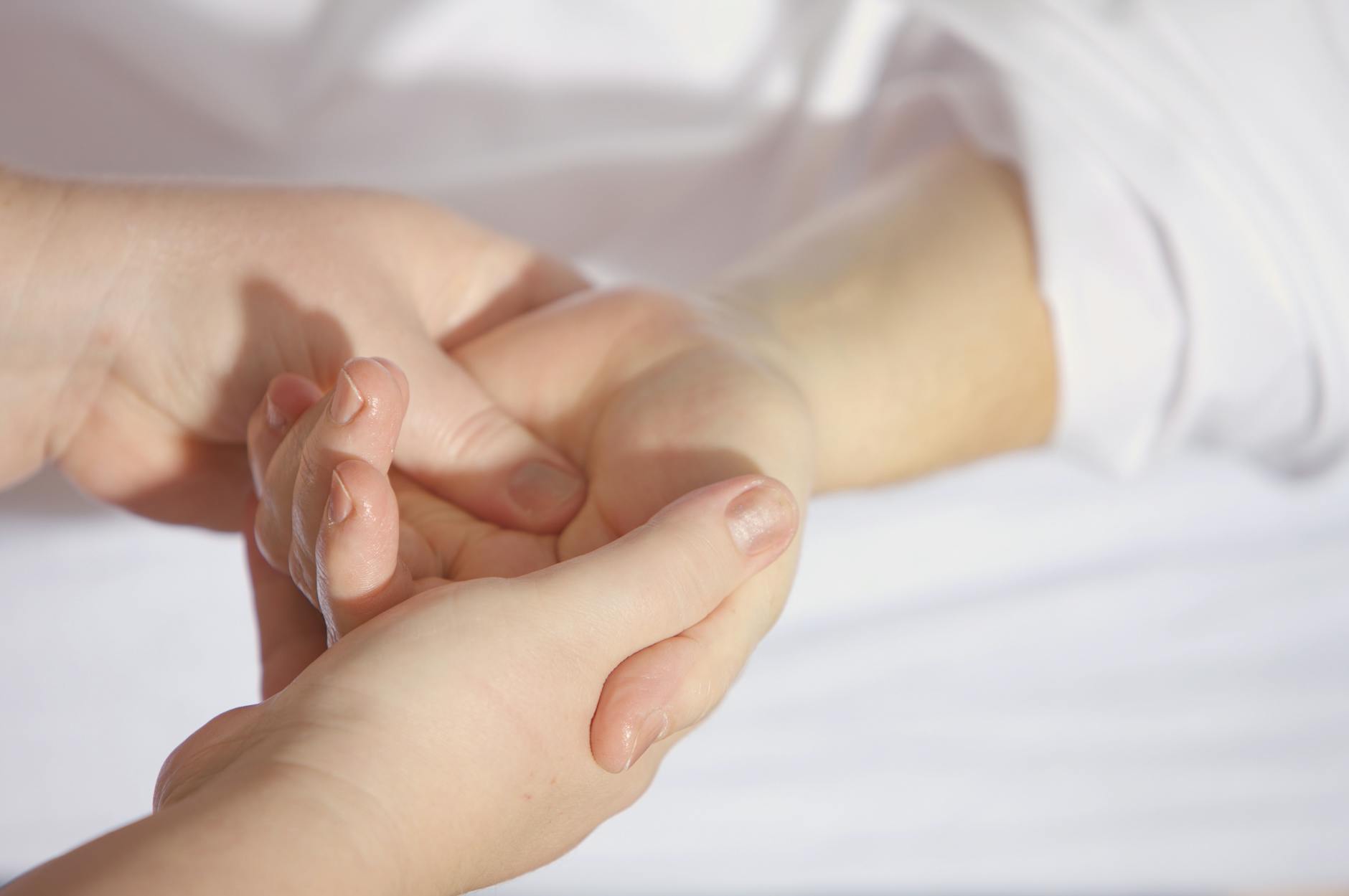
From there, the practitioner places both hands on specific points, holds them, and waits. That's it. There's no kneading, no pressure, no guided breath. The hold is maintained until the practitioner feels a shift, often described as a pulsing or softening beneath the hands, before moving to the next point in the sequence. Some clients feel warmth spreading through the body, a tingling in distant limbs, or an involuntary deep breath. Others feel nothing much during the session and notice the difference hours later, in their sleep or their mood.
Jin shin jyutsu also teaches a self-help practice. Each finger is associated with a specific emotional quality: the thumb relates to worry, the index finger to fear, the middle finger to anger, the ring finger to sadness, and the little finger to effort or trying too hard. Wrapping one hand gently around the opposite finger and holding it for a few minutes is a simple way to begin working with these associations at home. It sounds too easy to matter. Many people find it surprisingly settling.
Who tends to find it useful
Jin shin jyutsu is used by people managing chronic pain, anxiety, fatigue, digestive issues and sleep disruption. It's also practised in some palliative care and oncology settings internationally, where its gentleness makes it appropriate even for people whose bodies are under significant physical strain. The Jin Shin Jyutsu Institute in Scottsdale, Arizona, the organisation founded by Mary Burmeister's work, maintains a register of trained practitioners and continues to offer seminars worldwide.
Jin shin jyutsu isn't a treatment for specific medical conditions, and no responsible practitioner will frame it that way. It's a support practice. It works alongside conventional medicine rather than instead of it, and its value lies in what sustained, attentive stillness does for a nervous system that rarely gets to properly rest. If you're someone drawn to somatic approaches to wellbeing, the underlying logic will feel familiar: the body holds more than we give it credit for, and creating the right conditions often allows it to reorganise itself.
What to expect after a session
The most common response in the hours following a jin shin jyutsu session is tiredness. Not a dragging fatigue, but the kind of heaviness that arrives when the body finally stops bracing. Some people sleep deeply that night for the first time in weeks. Others notice a lightness or clarity they can't quite attribute to anything specific.
Occasionally, there's what practitioners call a "healing response": a temporary intensification of symptoms, a bout of emotional release, or vivid dreams. These tend to pass within 24 to 48 hours and are generally understood as the body processing what shifted during the session. Drinking plenty of water in the hours after a session is standard advice, for similar reasons to those given after lymphatic work or deep tissue massage.
Three or four sessions usually give a clearer picture of whether jin shin jyutsu suits you. Some people feel an immediate and strong response. Others need a few sessions before the pattern becomes clear. Either way, the practice rewards patience and an open curiosity more than any particular belief in how it works.