
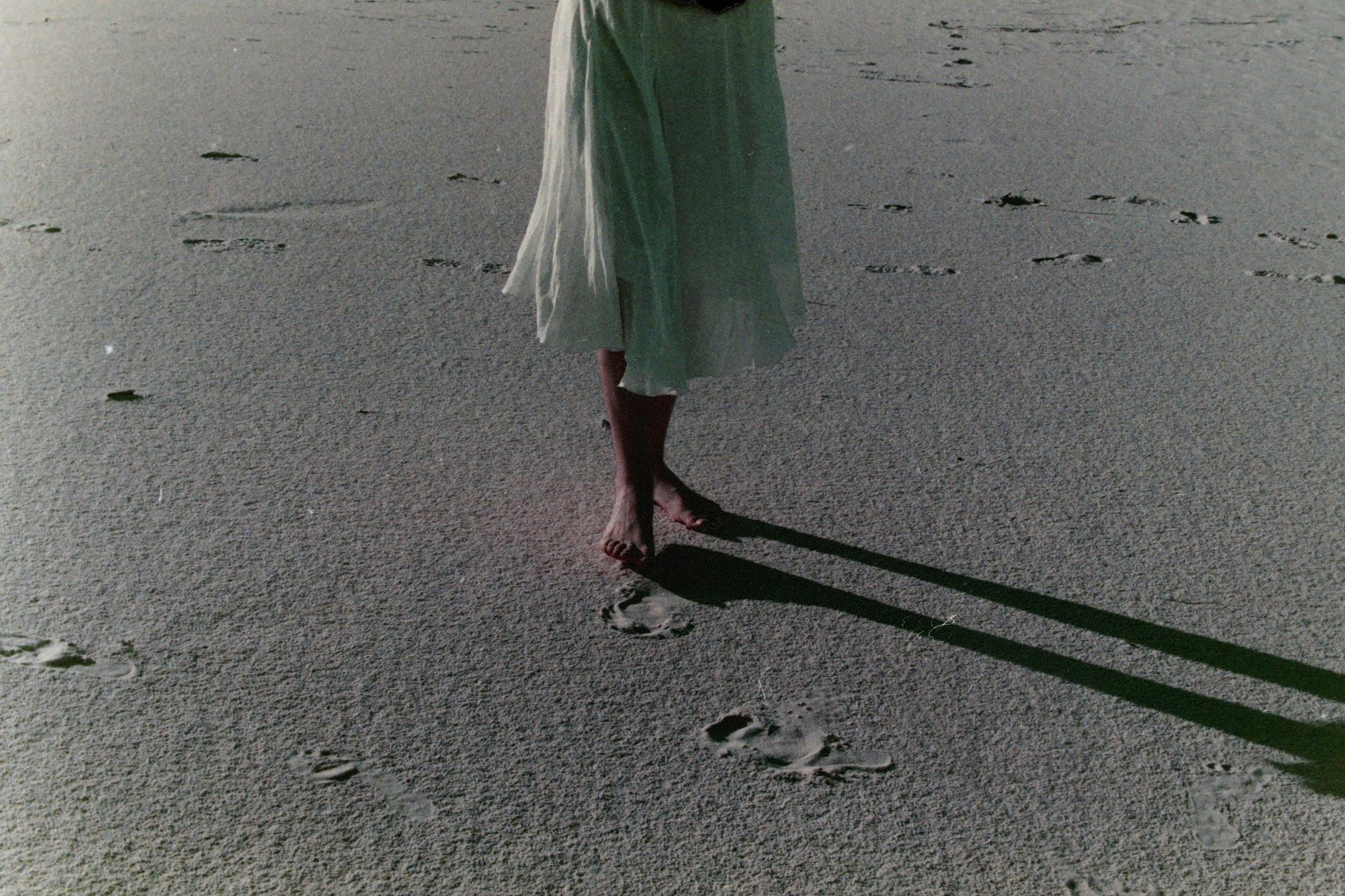
Mindful walking is exactly what it sounds like, and nothing like how most people walk. It isn't about slowing to a shuffle or chanting silently. It's about bringing deliberate attention to something your body already knows how to do, and letting that shift how your nervous system feels for the rest of the day. Most people discover it almost by accident, on a beach walk that somehow left them calmer than when they started.
Why walking is different from sitting meditation
Seated meditation asks you to hold still while the mind moves. Mindful walking inverts that: your body moves while you ask the mind to settle. For people who find stillness frustrating, this is often the easier entry point. There's always something to anchor to. The weight of your foot as it presses down. The swing of your arms. The temperature of the air on your forearms.
The body in motion gives the thinking mind something concrete to follow rather than abstract thought to wrestle. That's not a compromise. It's a different mechanism entirely, and for anxiety in particular, it tends to work faster than stillness. Movement burns off some of the cortisol that makes sitting feel impossible. You settle into the practice rather than fighting your way into it.
If breathwork appeals to you for similar reasons, the 4-7-8 breathing technique pairs well with mindful walking as a way to deepen the calming effect before or after your walk.
How to actually do it: the core method
Start with five minutes. Not twenty. Five minutes of genuine attention beats twenty minutes of distracted plodding.
Before you take your first step, pause. Feel both feet on the ground. Notice the contact points: heel, ball, toes. Take one slow breath through your nose. Then begin to walk at a pace slightly slower than usual, not conspicuously slow, just unhurried.
As you walk, alternate your attention between three anchors:
- Sensation: What does the ground feel like underfoot? Is it hard, soft, uneven? What does the air feel like on your skin?
- Sound: What's the soundscape around you? Don't label or judge. Just notice.
- Sight: Let your gaze be soft rather than scanning. Look slightly ahead of you, not down at your phone.
When your mind wanders (and it will, immediately), bring it back to whichever anchor is most vivid in that moment. No frustration required. Wandering and returning is the practice. That's the repetition that trains attention.
Where you walk genuinely matters
The environment shapes how easy or hard this is. Paths with high foot traffic and constant noise ask more of your attention than quieter routes. That's not disqualifying, urban walking can be deeply meditative once the skill is built, but beginners do better starting somewhere with less sensory competition.
Natural settings accelerate the process noticeably. Trees, water, birdsong, uneven terrain all give the senses something rich to anchor to without demanding cognitive processing. The research behind forest bathing points to the same mechanism: nature reduces cortisol, lowers blood pressure and shifts the nervous system toward rest without you having to try.
Rainbow Beach and the Cooloola Coast offer some of the best walking environments for this practice in Queensland. The tidal flats at low tide, the dune tracks above Carlo Sand Blow, the shaded wallum heathland paths. Each one offers a completely different sensory anchor and a different quality of quiet.
Common mistakes that undercut the practice
Walking with earphones in is the most common one. Music and podcasts aren't bad in themselves, but they replace the sensory environment rather than letting you inhabit it. Save the podcast for a different walk.
The second mistake is treating it as exercise. The moment you start tracking pace or step count, the quality of attention shifts. You're optimising rather than noticing. Keep your phone in your pocket and your watch ignored for the duration.
Third: destination focus. Mindful walking works best when it isn't a commute in disguise. If you're mentally running through what you'll do when you arrive, you've already left the practice. If you need to get somewhere, give yourself extra time so the walk itself can breathe.
Building it into your day without adding to your load
The practical appeal of mindful walking is that it doesn't require new time. It requires attention applied to time you're already spending. Walk to the letterbox slowly and without your phone. Take the long way around the car park. Walk to the corner and back before making a difficult phone call.
These aren't grand gestures. They're the same principle as micro-pauses placed deliberately throughout your day: small interruptions to automatic pilot that accumulate into a measurably calmer nervous system over weeks.
Once five minutes feels natural, extend to ten. Then fifteen. Most people find that twenty minutes of mindful walking in a natural setting provides a quality of reset they previously only found in formal meditation, sometimes more reliably. It earns its place as a daily anchor, not because it's spiritual, but because it works.
What changes with regular practice
After two or three weeks of daily practice, most people notice the same cluster of shifts. They catch themselves less often in anxious loops. They sleep a little more easily. They feel more present in conversations. None of this is dramatic. That's the point. Mindful walking doesn't produce peak experiences. It lowers the baseline hum of stress so consistently that, after a month, you notice its absence on the days you skip it.
That's the sign the practice has taken hold. Not that something remarkable happened on the walk. That something quieter is happening everywhere else.