
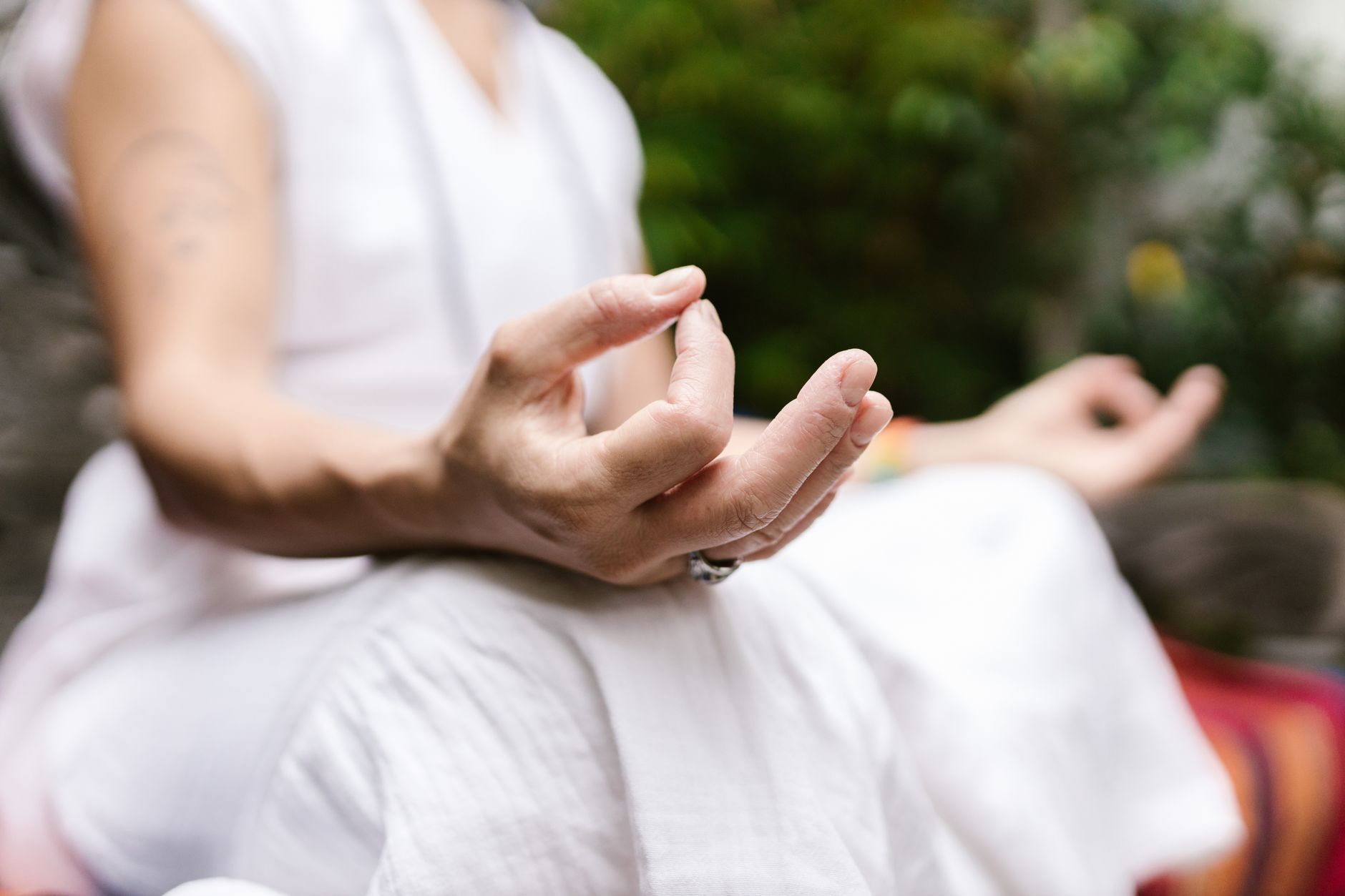
Mudra practice sits quietly at the edge of most people's wellness knowledge. You've probably seen a meditating figure with fingers touching in a circle and thought nothing more of it. But that gesture, the chin mudra, is part of a system stretching back at least 5,000 years through Indian yoga and Ayurvedic medicine, used deliberately to shift energy, focus, digestion, emotional state and nervous system tone. You need no equipment, no studio, and no prior experience to begin.
What mudras actually are
The word mudra comes from Sanskrit and translates loosely as "seal" or "gesture." In yogic tradition, mudras direct the flow of prana (life force energy) through the body by creating circuits in the hands and fingers. Each finger corresponds to one of the five elements: the thumb to fire, the index finger to air, the middle finger to space, the ring finger to earth, and the little finger to water. Bringing specific fingers into contact changes the elemental balance your body expresses in that moment.
That framework may or may not resonate with you, and it doesn't have to. What's harder to dismiss is that the hands contain a remarkable density of nerve endings and occupy a disproportionately large portion of the brain's sensory and motor cortex. Deliberate hand positions send real neurological signals. The gesture is the mechanism, whatever framework you choose to understand it through.
Four mudras worth starting with
These four are practical entry points. Each one takes under a minute to form and can be held for anywhere from 3 to 30 minutes, seated or lying down.
Chin mudra (consciousness gesture)
Rest the backs of your hands on your thighs. Touch the tip of your index finger to the tip of your thumb, forming a circle. Keep the other three fingers relaxed and extended. This is the mudra most associated with meditation. It's used to settle a scattered mind and bring a quality of receptive alertness. Hold it during breathwork or a body scan to notice how it anchors attention.
Gyan mudra (knowledge gesture)
Gyan looks almost identical to chin mudra but with palms facing upward. The upward-facing position is associated with openness rather than containment. It's the mudra teachers often recommend when you feel mentally heavy or stuck, as if the problem is circling without resolution.
Apana mudra (downward energy gesture)
Touch the tips of your middle and ring fingers to the tip of your thumb. Index and little fingers extend outward. Apana mudra is linked in Ayurveda to elimination and release, both physical (it's traditionally recommended to support digestion) and emotional. Many practitioners use it when they're holding tension they'd like to let go. Try holding it for 15 minutes after a large meal or before bed when the day hasn't quite left you.
Prana mudra (life force gesture)
Touch the tips of your ring finger and little finger to the tip of your thumb. Index and middle fingers extend. This is a revitalising mudra, used when energy is genuinely low rather than when the mind is simply scattered. It's distinct from the jittery lift of caffeine. Practitioners describe it as a quieter, more grounded kind of alertness. Ten minutes is often enough to notice a shift.
How to build a mudra practice
Start with one mudra and one consistent context. Morning meditation is the most obvious pairing: a breathwork session for beginners becomes measurably different when you add a hand gesture, because the physical anchor keeps attention from drifting. That's not mysticism; it's the same principle behind using a mantra or a candle flame.
Three minutes is a legitimate starting point. You don't need to sit cross-legged on a mat. A chair works. A bed works. The hands simply need to be relaxed enough to hold the position without gripping. If your shoulders creep upward after a few minutes, that's a signal to lower your arms and rest them on your thighs.
Consistency across days matters more than duration in any single session. Practising for five minutes every morning for two weeks will tell you far more about whether mudras are useful for you than a single 30-minute experiment.
Pairing mudras with other holistic practices
Mudras combine naturally with practices that already involve stillness. Nadi shodhana (alternate nostril breathing) is one of the most effective pairings: this breathing practice calms the nervous system on its own, and using gyan mudra with the non-active hand during the sequence deepens the effect noticeably. The hand that isn't directing the breath has something to do, which prevents it from becoming a source of distraction.
Sound healing sessions, body scan meditations and restorative yoga are also natural contexts. In each case the mudra gives the hands a role in the practice rather than leaving them as afterthoughts at your sides.
What to expect (and what not to)
Some people feel a warmth, tingling or subtle shift in attention within a few minutes. Others feel nothing in the early sessions and notice the effect only in retrospect, when they've practised for a fortnight and realise their mornings feel different. Neither response is more correct than the other.
Mudra practice isn't a substitute for sleep, nutrition or medical care. It's a fine-tuning instrument, not an emergency tool. Apana mudra won't resolve a digestive condition that needs medical attention. What it will do, used consistently, is give your hands a purposeful role in your self-care rather than leaving them idle while your mind tries to settle on its own.
Start with chin mudra tomorrow morning. Hold it for five minutes. That's the whole instruction.