
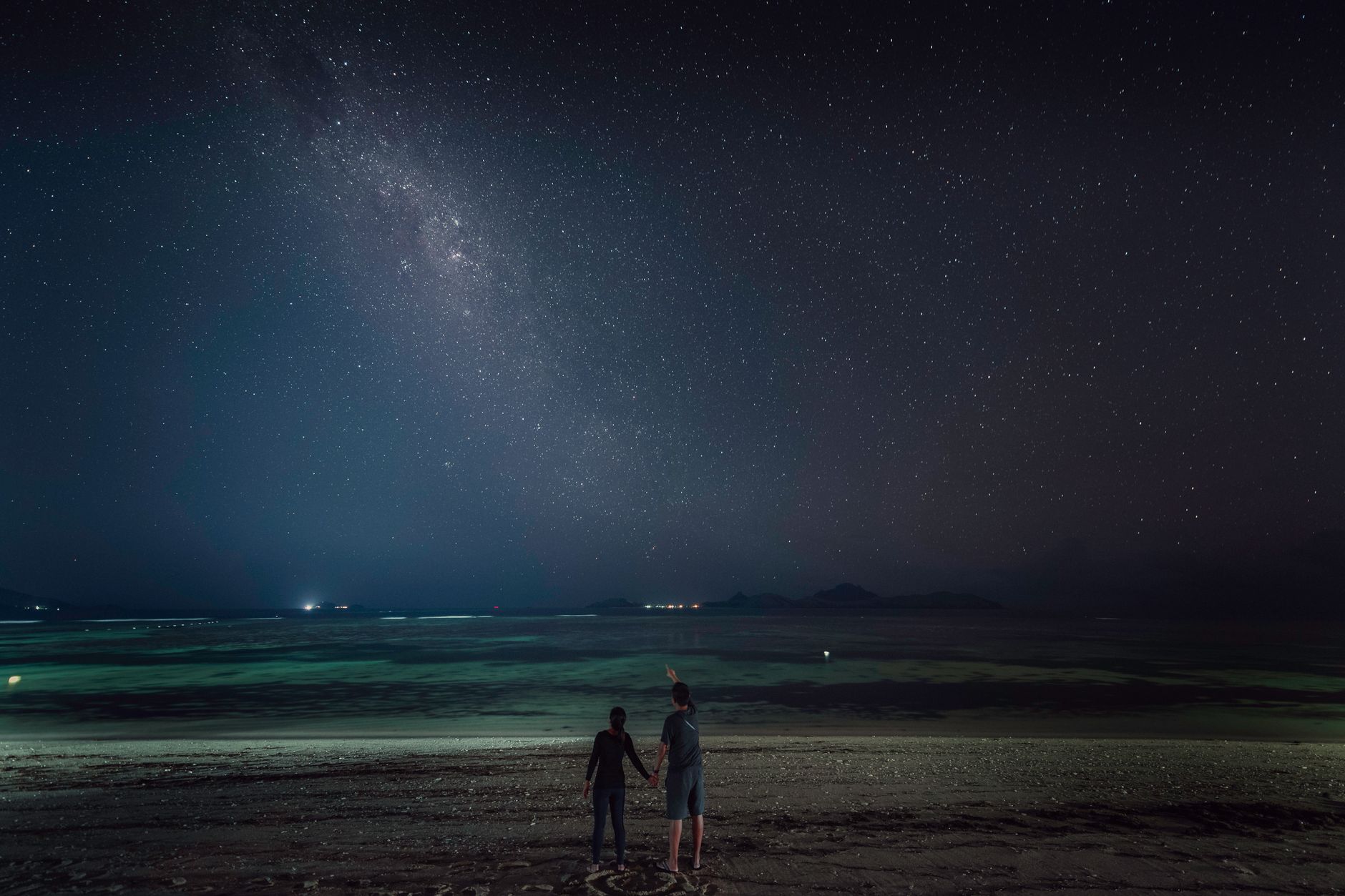
Stargazing at Rainbow Beach is one of those experiences that catches people off guard. Most visitors arrive for the coloured sand cliffs and the surf, and they leave talking about the night sky. The township sits at the southern edge of the Great Sandy National Park, far enough from Brisbane and the Sunshine Coast to escape the worst of their light pollution. On a clear, moonless night, the Milky Way arches overhead in a way that feels almost implausible if you've only ever seen it from a city.
Why the skies here are so good
Light pollution is the enemy of stargazing, and Rainbow Beach has very little of it. The national park to the north and west acts as a natural buffer, and the township itself is small enough that it doesn't generate much sky glow. The beach faces east, so there's no artificial light from the horizon in that direction. On nights when the moon is new or hasn't yet risen, the darkness is deep enough to see the Milky Way core with the naked eye. That's a rarity in coastal Queensland.
Humidity matters too. The best nights tend to follow a dry westerly air mass, which clears the atmosphere and sharpens contrast. Summer evenings (December through February) are often warm but hazy; the winter months from May to August typically offer the crispest skies. Humidity drops, cloud cover is lower, and the Milky Way's galactic centre sits high enough to photograph well.
The best spots to set up
The beach itself is the simplest option. Walk 10 minutes south from the main beach access, away from the car park lights, and you'll find a wide, flat stretch with an uninterrupted horizon in every direction. Bring a blanket and lie flat. Your eyes take about 20 minutes to fully dark-adapt, so resist checking your phone once you've set up.
The lookout above the township offers a slightly different vantage. It faces north over the coloured cliffs, and on clear nights you can watch stars rise over Double Island Point. It's a shorter walk and easier for families with young children. Carlo Sandhills, a short drive south, is worth the extra effort: the elevated dune ridges block any residual town light and give you a 360-degree horizon.
Inskip Point is another option, particularly if you're camping there already. It sits right at the water's edge where the strait between the mainland and Fraser Island opens up. There's nothing between you and the eastern horizon, and the bioluminescence in the shallows occasionally adds a surreal second layer to the experience.
What to look for in the sky
The Southern Cross is the obvious starting point for anyone new to southern hemisphere skies. It's not large, but it's unmistakable once you know it, and it points reliably south. From the Cross, you can trace the Milky Way across the sky in both directions: toward the bright core above Sagittarius to the north, or toward the fainter outer arm stretching south.
The Magellanic Clouds are two irregular dwarf galaxies visible to the naked eye from dark sites in the southern hemisphere. The Large Magellanic Cloud looks like a detached chunk of the Milky Way; the Small Magellanic Cloud is fainter but still visible without optical aid on a clear night. Both are present in the southern sky from April through October.
Jupiter and Saturn are worth identifying if they're up. Saturn's rings are visible in even a modest pair of binoculars (7x50 is ideal). Jupiter's four largest moons, first described by Galileo in 1610, appear as a short line of dots either side of the planet. You don't need a telescope to see them. A single pair of binoculars is genuinely transformative for beach stargazing.
Practical tips before you go
Pack a red-light torch rather than a white one. Red light preserves your night vision; white light destroys it instantly. Most outdoor retailers stock them, and some headlamps have a red-mode switch. Dress warmer than you think you need to. Even in summer, lying still on sand at midnight gets cold faster than expected.
A free app like Stellarium will identify anything you point your phone at, but set the display to night mode (red tint) before you head out so it doesn't ruin your dark adaptation. Check the lunar calendar before planning your trip: a full moon is beautiful, but it washes out everything except the brightest stars and planets. The nights around a new moon are best.
If you're staying at a private retreat rather than a campground, you'll likely have direct beach or dune access without crowds. That kind of quiet privacy makes a real difference when you're trying to stay still and patient under the stars. Stargazing pairs naturally with the kind of rest and reflection that a Rainbow Beach wellness itinerary is built around. It asks nothing of you except time and attention.
Connecting the experience to the rest of your stay
There's something specific about lying under a genuinely dark sky that the wellness world doesn't talk about enough. It induces a kind of perspective shift that no meditation app replicates. The scale of it is physical: you feel small in a way that's oddly calming rather than threatening. That response is partly what makes Rainbow Beach such a natural fit for people who come here to decompress.
The grounding that comes from direct contact with the natural world is well documented, and stargazing from the beach adds a dimension to that: bare feet in the sand, body horizontal, gaze open to the sky. It's one of the least effortful ways to feel genuinely present. Do it on your first night and it tends to set the tone for the rest of the trip.
Bring your own star map if you're old-fashioned about it. Or just arrive, let your eyes adjust, and wait. The sky will do the rest.